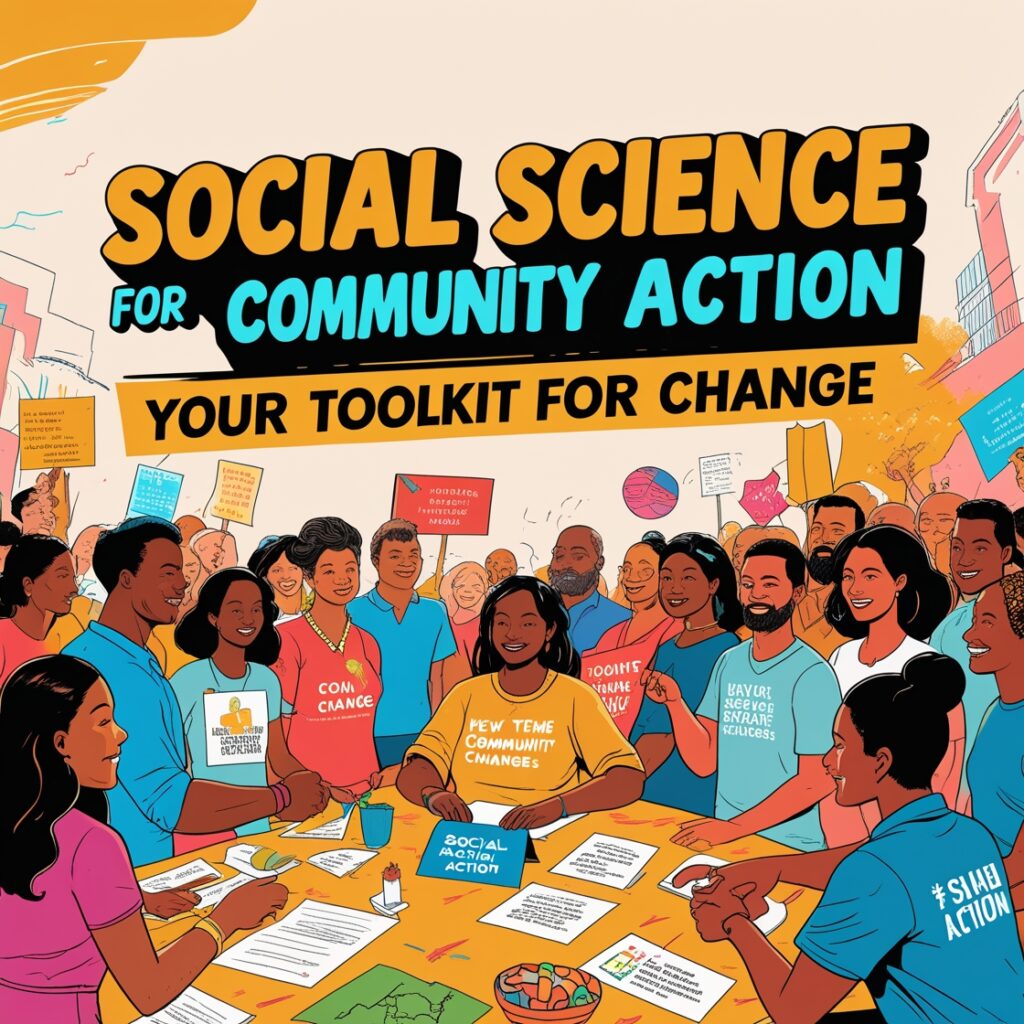

Hey, future social scientist! Let’s explore the top methods used by researchers and activists to drive community action. Think of these as your “power tools” for solving real-world problems. Let’s get hands-on! 🔧🌍
Step 1: Icebreaker – What’s Your Method?
💬 Quick Think:
If you wanted to fix a problem in your community (e.g., trash pile-up), would you…
- Interview neighbors to find out why it’s happening?
- Organize a cleanup crew with locals?
- Map which households are most affected?
There’s no wrong answer—different tools for different jobs!
Step 2: Method 1 – Participatory Action Research (PAR)
💡 What It Is:
Research done WITH the community, not ON them.
🌟 Features:
- Community members co-design the project, collect data, and brainstorm solutions.
- Focuses on empowerment and social change.
🌍 Example:
A coastal village in the Philippines used PAR to address overfishing. Fishers, scientists, and youth mapped fish stocks and created no-fishing zones together.
Step 3: Method 2 – Community-Based Participatory Research (CBPR)
💡 What It Is:
Like PAR, but with a focus on equitable partnerships between academics and communities.
🌟 Features:
- Shared decision-making and resource ownership.
- Often used in health projects.
🌍 Example:
In the U.S., a CBPR project partnered with Indigenous communities to design culturally relevant diabetes prevention programs.
Step 4: Method 3 – Ethnography
💡 What It Is:
Living with a community to deeply understand their culture and challenges.
🌟 Features:
- Researchers immerse themselves in daily life (e.g., markets, festivals).
- Great for uncovering hidden issues.
🌍 Example:
An anthropologist lived in a slum in Mumbai to study how residents access clean water, leading to better NGO interventions.
Step 5: Method 4 – Case Study Approach
💡 What It Is:
Zooming in on one community or project to learn “what works.”
🌟 Features:
- Combines interviews, observations, and documents.
- Useful for sharing success stories.
🌍 Example:
A case study on Rwanda’s community health workers inspired similar programs in Nigeria.
Step 6: Method 5 – Surveys & Interviews
💡 What It Is:
Collecting data through questionnaires or conversations.
🌟 Features:
- Surveys : Quantitative (numbers) to spot trends.
- Interviews : Qualitative (stories) to understand “why.”
🌍 Example:
A youth group in Kenya used surveys to prove that girls drop out of school due to period stigma, leading to free pad distributions.
Step 7: Method 6 – Social Network Analysis
💡 What It Is:
Mapping relationships to see who’s connected (or excluded).
🌟 Features:
- Uses diagrams to show power dynamics or resource flows.
- Helps identify leaders or gaps.
🌍 Example:
In Brazil, activists mapped networks to ensure marginalized voices were included in city planning.
Step 8: Method 7 – Asset-Based Community Development (ABCD)
💡 What It Is:
Focusing on a community’s strengths , not just problems.
🌟 Features:
- Identifies local talents, resources, and traditions.
- Builds pride and self-reliance.
🌍 Example:
A Detroit neighborhood used ABCD to revitalize empty lots using skills of retired carpenters and artists.
Step 9: Method 8 – Advocacy & Empowerment Approaches
💡 What It Is:
Training communities to demand their rights through protests, lobbying, or art.
🌟 Features:
- Inspired by Paulo Freire’s “critical pedagogy.”
- Focuses on systemic change.
🌍 Example:
The #FeesMustFall movement in South Africa used student-led protests to challenge university fees and colonial education systems.
Step 10: Method 9 – Mixed Methods
💡 What It Is:
Combining surveys (numbers) + interviews (stories) for a fuller picture.
🌟 Features:
- Balances breadth and depth.
- Great for complex issues like poverty or climate change.
🌍 Example:
A study on homelessness in Manila used surveys to count affected people and interviews to share their life stories.
Step 11: Method 10 – Participatory Evaluation
💡 What It Is:
Letting the community assess whether a project succeeded.
🌟 Features:
- Uses storytelling, voting, or scorecards.
- Ensures accountability.
🌍 Example:
Farmers in Uganda evaluated a water project by rating its impact on their crop yields and family health.
Step 12: Your Turn to Choose!
🚀 Homework Challenge:
- Today : Pick one method and research it further.
- This Week : Interview a family member about a community issue—use open-ended questions!
- This Month : Join a local project using one of these methods.
💬 Final Thought:
“The best solutions come from the people closest to the problem.” – adrienne maree brown