
Hey, community champion! Let’s build a participatory action plan —a roadmap for change that actually reflects what people need. No more “experts” deciding alone! Let’s do this step-by-step. 🗺️✊
Step 1: Icebreaker – Your Community’s Superpower
💬 Quick Share:
What’s one thing your community already does amazingly well?
(Example: “We throw epic festivals!” or “We always help flood victims!”)
Step 2: Phase 1 – Prep Work (Build Trust)
🌟 Key Steps:
- Meet Stakeholders : Chat with local leaders, elders, youth, and marginalized groups (e.g., street vendors, disabled residents).
- Form a Core Team : Include diverse voices (e.g., a teacher, a farmer, a teen activist).
- Set Ground Rules : Agree on respect, honesty, and “no bad ideas” during brainstorming.
🌍 Example:
In India, a core team included Dalit women, farmers, and teachers to plan water projects.
Step 3: Phase 2 – Participatory Assessment (Find the Real Issues)
🌟 Tools to Use:
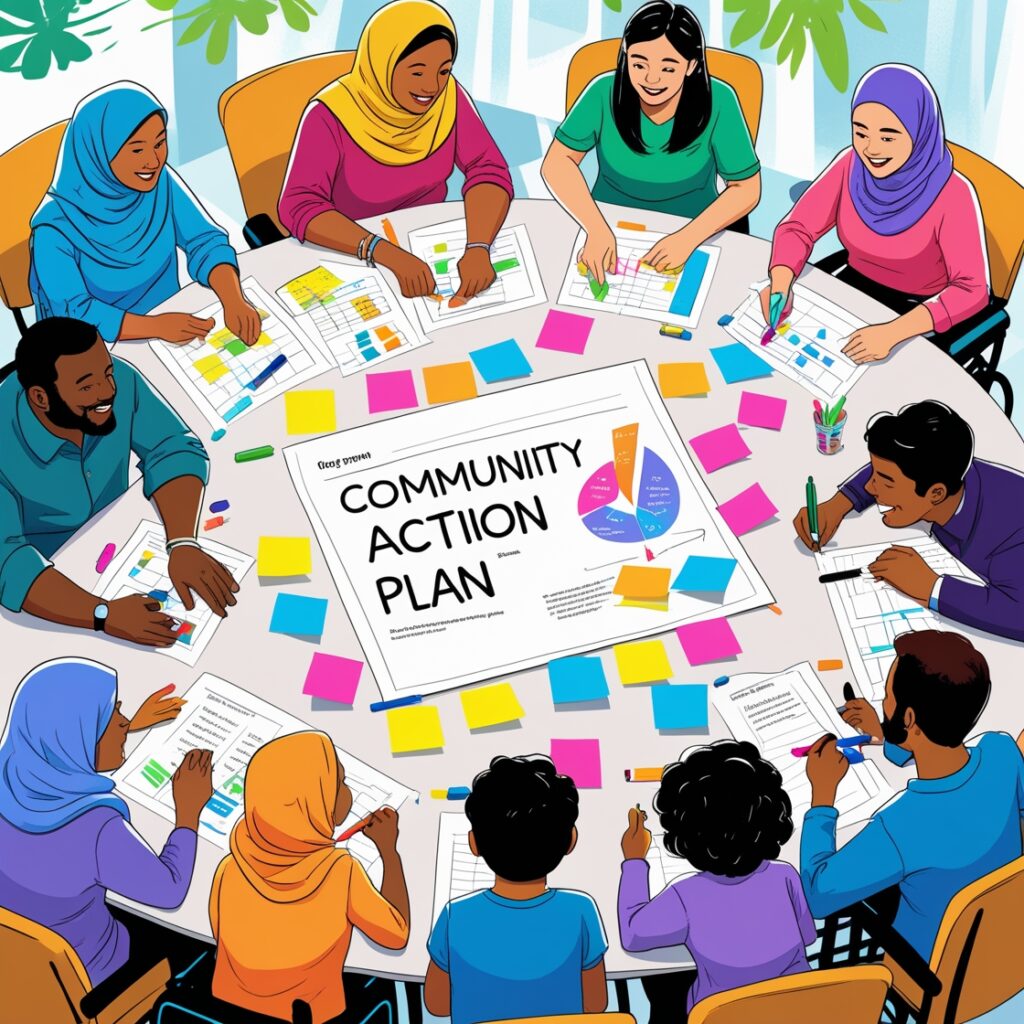
- Community Mapping : Draw a map of the area. Add sticky notes for problems (e.g., broken wells, trash piles).
- Focus Groups : Split into small groups (youth, elders, etc.) to discuss challenges.
- Surveys : Use simple yes/no questions or emojis (❤️/💔) for quick feedback.
💡 Activity:
Host a “Problem Tree” workshop. Draw a tree where the “roots” are causes (e.g., no jobs) and “leaves” are effects (e.g., crime).
Step 4: Phase 3 – Goal Setting (Dream Together)
🌟 How:
- Prioritize Issues : Vote on which problems to tackle first.
- SMART Goals : Make goals Specific, Measurable, Achievable, Relevant, Time-bound.
🌍 Example:
Goal : “Install 10 clean water taps in Barangay X by 2025” (instead of “Fix water issues”).
Step 5: Phase 4 – Action Planning (Who Does What?)
🌟 Steps:
- Brainstorm Solutions : Host a “Solution Slam” where everyone pitches ideas.
- Assign Roles :
- Leaders : Who coordinates each task?
- Volunteers : Who helps with cleanup, fundraising, etc.?
- Timeline : Use a calendar to set deadlines.
📱 Pro Tip:
Use free apps like Trello or a WhatsApp group to track tasks.
Step 6: Phase 5 – Implementation (Make It Happen!)
🌟 Keys to Success:
- Leverage Local Resources : Use donated materials, local skills (e.g., a carpenter builds benches).
- Stay Transparent : Share updates via posters, radio, or social media.
🌍 Example:
In Kenya, a community built a playground using recycled tires and volunteer labor.
Step 7: Phase 6 – Monitor & Evaluate (Did It Work?)
🌟 Tools:
- Feedback Loops : Hold monthly check-ins with the core team.
- Scorecards : Rate progress (e.g., 1-5 stars).
- Celebrate Wins : Throw a party when milestones are hit!
💡 Activity:
Create a “Before vs. After” photo gallery to show progress.
Step 8: Phase 7 – Sustain & Scale (Keep the Momentum)
🌟 Strategies:
- Train Leaders : Pass the torch to new volunteers.
- Share Stories : Post success on TikTok/Instagram to inspire others.
- Advocate : Push local gov’t to fund similar projects.
🌍 Example:
A Philippines community’s flood-prevention project got national funding after sharing their story online.
Step 9: Sample Action Plan – Clean Water for All
| Step | Action | Who | When |
| 1. Fundraising | Crowdfund for water filters | Youth Group | Jan-Mar 2024 |
| 2. Install Taps | Partner with engineers | Core Team + Volunteers | April 2024 |
| 3. Educate | Workshops on water conservation | Teachers + Elders | Ongoing |
Step 10: Your Turn!
🚀 Take Action:
- Today : Chat with 3 neighbors about their top concern.
- This Week : Host a “Problem Tree” workshop.
- This Month : Draft your first participatory action plan!
💬 Final Thought:
“Plans are nothing; planning is everything.” – Dwight Eisenhower