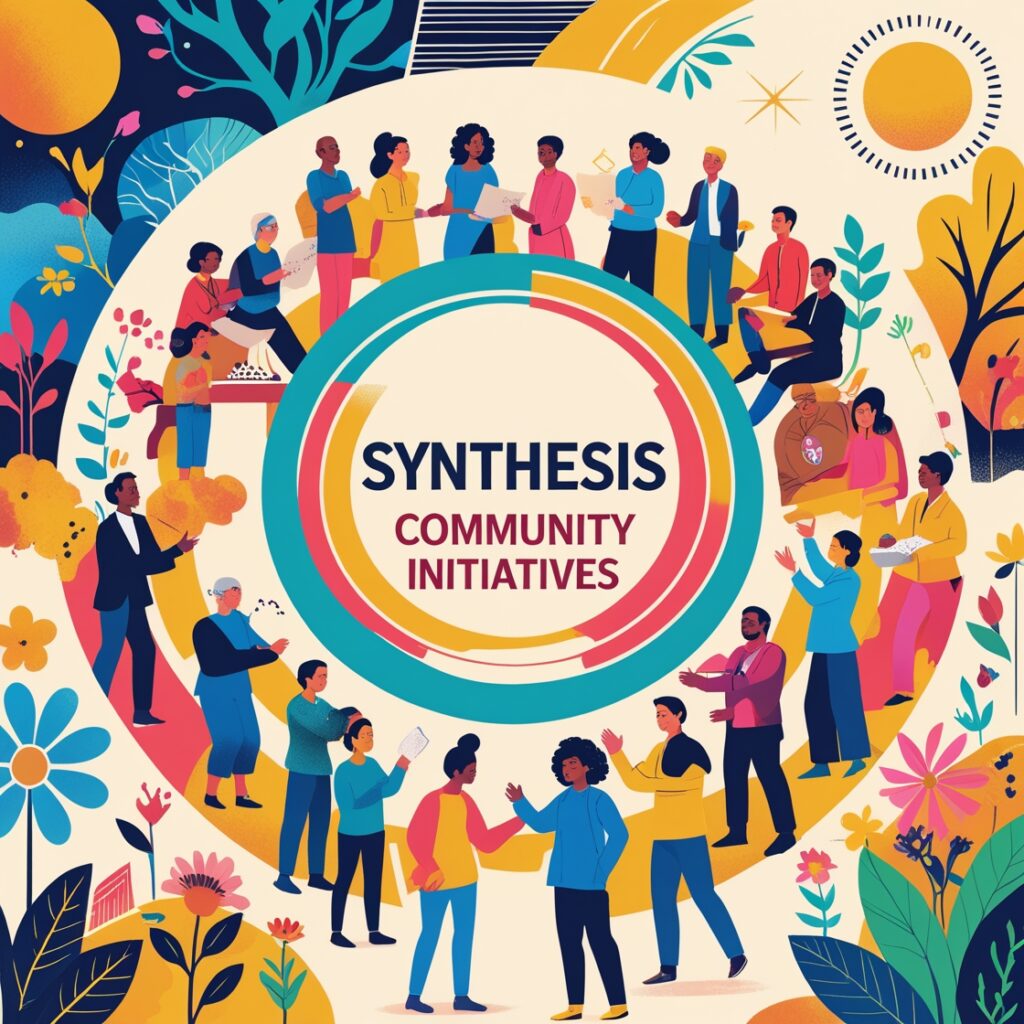

Implementing community action initiatives is like conducting an orchestra—every instrument (method, voice, resource) must harmonize to create something beautiful. Here’s how it all comes together:
1. The Tapestry of Integration
Weaving Threads into Wholeness
- Theory + Practice : Social sciences (sociology, psychology) inform how we act, while hands-on work (cleanups, advocacy) tests those theories.
- Participation + Empowerment : Communities don’t just “receive” solutions—they co-create them, blending local wisdom with external expertise.
- Process + Outcome : Success isn’t just the end goal (e.g., a new park) but the journey of building trust, skills, and ownership.
🌍 Example :
A housing project in Kenya succeeded because it merged:
- Anthropology (understanding family needs),
- Political Science (lobbying for land rights),
- Economics (microloans for construction),
- Community Voice (designing layouts together).
2. The Spiral of Learning & Action
Cycle of Continuous Growth
- Plan : Use social science research to identify root causes (e.g., surveys, ethnography).
- Act : Partner with locals, NGOs, and governments to pilot solutions.
- Reflect : Evaluate what worked (e.g., participatory feedback sessions).
- Adapt : Tweak strategies based on lessons learned.
💡 Insight :
Every failure (e.g., a failed recycling program) becomes data for the next iteration.
3. Challenges as Catalysts
Turning Roadblocks into Bridges
- Resistance : Use psychology to address fears (e.g., workshops on “loss aversion”).
- Power Imbalances : Apply sociology to amplify marginalized voices in decision-making.
- Resource Gaps : Leverage anthropology to barter skills (e.g., art for ad space).
🌍 Example :
When a Philippines flood-prevention project faced pushback, organizers hosted story circles to rebuild trust—blending empathy (psychology) with cultural rituals (anthropology).
4. The Ripple Effect
Beyond the Immediate Impact
- Capacity Building : Participants gain skills (e.g., leadership, data analysis) that spark future projects.
- Networks : Partnerships formed (e.g., schools + businesses) outlast the initiative.
- Cultural Shift : Norms change (e.g., gender equality in decision-making).
🌍 Example :
India’s Self-Employed Women’s Association (SEWA) started as a microloan project but evolved into a global movement for labor rights.
5. Your Integrative Legacy
How to Keep the Momentum
- Document : Share stories (podcasts, murals) to inspire others.
- Mentor : Train newcomers in participatory methods.
- Advocate : Push for policies that institutionalize community-led solutions.
💬 Final Thought:
“Community action isn’t a checklist—it’s a living ecosystem where every action feeds into the next.” – Sir Eugene